What’s The Most Expensive Diamond Cut? Here Are The Top Shapes & How To Save Money When You Buy
There are a gazillion ways you can go with a rough diamond. But without the right cut even the highest-quality stone may never meet its full potential. In the same way a haircut can highlight particular facial qualities, a diamond’s qualities can be brought out by it’s cut.
Below we cover the most expensive diamond cuts and give you some tips on how to make them a little less expensive.
Let’s get right to it…
How Are Diamond Cuts Compared?
Cost : One of the most important factors in cost per carat is how much rough stone is wasted during cutting. For this reason, the least expensive diamond cuts are the Asscher and Emerald cuts, which lose an average of 20% of the rough stone. Compared with the average 60% loss that occurs when a round diamond is cut.
Carats: Carat weight is important because diamonds come in different shapes and dimensions. Because each cutting style removes different amounts in different locations of the original rough stone, two stones that have the same carat weight can look like they are different sizes. In other words, if you were to cut the same stone in two different styles, one might look like it has more carats-–but not so.
Face-up Size: The initial impression of a diamond’s overall size is influenced by the face-up size (also called table-up). It refers to how big the surface area appears when you look down at the top of the stone in its setting.
If you want a diamond to look bigger, the face-up size becomes important when planning its overall shape. Generally, the larger a diamond faces up, the shallower the total depth has to go to compensate. The result will be a diamond that will flash more than sparkle.
Surprisingly, a smaller face-up size isn’t a bad thing. If you want brilliance, you can trade down from a larger face-up size to a smaller one in order to increase the depth of the finished diamond. This trade-off can help create the brilliance that you are looking for.
Color: Most fancy colored diamonds are yellow, but they can also be grey, brown, purple, blue, orange, red, green and myriad of shades, tints and hues in-between. Colors are all measured by a rating system that ranges from D to Z. D, E and F are considered colorless. The further down the alphabet you go from a G rating, the more visible the yellow and brown hues become.
Clarity: Clarity refers to the amount of inclusions or imperfections in a stone. Grading ranges from cleanest to most included. High-clarity stones allow a wider choice of cuts like Asscher or emerald cuts, which reveal everything within the stone. Therefore, if you have a stone with a lower clarity grading, it’s best to stick with more highly-faceted cuts.
Chipping Potential: Diamonds with points and inclusions become vulnerable to chipping and breakage. Points diminish internal structural support. Inclusions interrupt the integrity of the interior molecular structure, creating structural weakness. One way around this is to protect the weak points by directly setting prongs over them.
The Most Popular Diamond Cuts
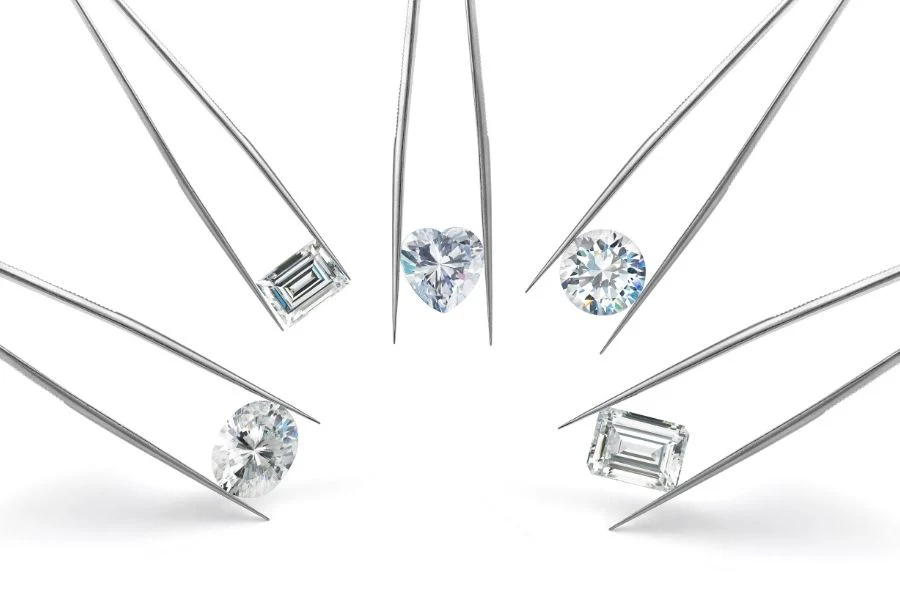
The 12 most popular and famous diamond cuts are:
- Round cut
- Princess cut
- Baguette cut
- Emerald cut
- Asscher cut
- Cushion cut
- Radiant cut
- Pear cut
- Heart cut
- Oval cut
- Trillion cut
- Marquise
Cut Significance
Cut can control how light will travel through, disperse within and escape a diamond’s interior. A good cut unlocks whatever is inside of a stone, emphasizing its features or hiding its flaws.
Why is the cut important in a diamond?
The cut is made to maximize a diamond’s light performance through a precise combination of factors. Cut can also make a diamond appear bigger or smaller than other diamonds of equal carat weight. Things like: the number of facets, their angles, size and shape–all determine how well a diamond can disperse light into the colors of the rainbow and send them out into the room.
What is a rough diamond?

Until cut, a diamond is almost unrecognizable—just dull and rounded like any ordinary rock. However, diamonds have internal sheets called cleavage planes. If struck with sufficient force from the right direction, they will break open. It is these planes that diamond cutters take advantage of when breaking open a rough stone and making the initial cuts.
What factors will determine a diamond’s sparkle?
Isn’t it a thing of beauty to watch a diamond play with the light? Those dancing sparkles are created in part by facets. Facets serve as mirrored surfaces that reflect, refract and disperse light into kaleidoscopic colors and patterns. Facets create sparkle through their numbers, shapes, sizes, symmetries, and locations.
The Cut Grades
Every diamond is assigned to one out of four grades by the GIA:
- Excellent – Highly brilliant and evenly patterned
- Very good – Also highly brilliant but perhaps includes some darker spots
- Good – Somewhat less scintillating and perhaps more dark areas than very good.
- Fair & poor – Very little brilliance and low degree of scintillation.
Cut grading is mainly determined by three factors: scintillation (fire and brilliance), pattern (facet arrangement) and contrast (the interplay between light and dark areas) and a few other factors like weight ratio, durability, polish, and symmetry.
Diamond Shapes and Prices
Using 1.0 carats and G color VS2 as a baseline, we get the following price averages:
- $7,291: Round brilliant
- $4,799: Princess
- $5,362: Oval
- $4,229: Cushion
- $5,802: Pear
- $4,443: Radiant
- $4,476: Emerald
- $4,137: Asscher
- $5,596: Marquise
- $5,536: Heart
Round Brilliant: The Most Expensive Diamond Cut

Sixty percent of a rough stone is lost when a round brilliant diamond is cut. Fifty percent of all cut diamonds sold in the United States and 75% of all diamonds sold worldwide are round brilliant cuts. Demand drives the market value and that value exponentially increases as their carat weight increases.
Pros
- Brilliance makes it appear larger than its actual size
- Out-sparkled every other cut but the new Royal201 for centuries
- Tried-and-true design that’s been around for 600 years
- Versatile enough that it goes well with any setting
- So brilliant that it even looks beautiful alone in a solitaire setting
Cons
- Most expensive cut diamond per carat across the board, regardless of carat weight.
Tight Budget Suggestions
A good strategy would be to go just shy of 1.0 carat. Your eye will not be able to tell the difference, but your wallet will. If you are willing to consider a little bit of downsizing as a practical trade-off, you can save 15-40% on the world’s most expensive cut.
While cut grade should not be compromised in this style, the color and clarity gradings offer some leeway. If you choose to go with a lower color grading, a setting other than white gold can help to offset the color difference- and make the diamond appear brighter and whiter. Moreover, this cut’s 57 facets can easily hide internal flaws.
Fancy Shapes: A Money Saver
Fancy shapes like oval, Marquis, heart and pear can save you money because less diamond waste incurred during the cutting. These shapes are unique and beautiful in appearance so if you’re on a budget, this is an easy way to save up to 25% when compared to a round brilliant diamond.
Cushion-Cut

The cushion-cut almost resembles a pillow or “cushion”, hence the name. It’s square with rounded corners and has more fire than brilliance when compared to round brilliant stones.
Pros
- Has excellent fire
- Priced 25-42% lower than round-cut diamonds
- Very good at hiding inclusions
Cons
- Smaller face-up than round-cut diamonds
- Range of color choices is fairly limited
Budget Suggestions
It may be best to stay at color grade H or above with this cut since it does not handle lower grades well. Also consider staying at SI1 or SI2 clarity and above for the same reason.
Heart Cut

This diamond is cut to look like a heart and given as a symbol of love and affection for your partner.
Pros
- Romantic
- It costs 13–26% less than rounds
- It is faceted to show brilliance
Cons
- Structurally weaker at the tip
- 7% smaller face-up than rounds
Budget Suggestions
This cut can go down a bit in both color and clarity grading and still be eye-clean.
Marquise cut

The Marquis is an oval diamond with pointed tips. This cut makes the diamond appear larger than it actually is and, because of its long shape, makes the wearers fingers look long and slender.
Pros
- Largest face-up size of all the shapes
- 15% larger face-up than rounds
- 10-25% less expensive than rounds
- Makes your finger look slimmer
Cons
- Points create structural weakness
- Easily chipped or broken
- Dark area called a “bowtie”
Budget Suggestion
This cut allows flexibility in clarity and color grades. If necessary you can compromise by setting your diamond in rose or yellow gold.
Pear Cut

The pear cut diamond is a teardrop shaped brilliant cut that has high sparkle and works well in many settings.
Pros
- Appears larger than actual size
- Makes your finger look slimmer
- 10-30% less expensive than rounds
- 8% larger face-up
Cons
- Pointed tip causes structural weakness
- Darkened area called “bowtie”
Budget Suggestion
Best to stay within H color and Si1 or SI2 clarity ratings
Princess-Cut

The princess cut has grown in popularity very quickly. It resembles a pyramid with the base of the stone being a point and the top (face up) being square with sharp edges.
Pros
- 40% less expensive than comparable rounds
- Similar brilliance and sparkle to round brilliant
- Appears larger than it is
Cons
- Corners are vulnerable to chipping
Budget Suggestion
Feel free to take advantage of this cut’s ability to hide inclusions: If you go any higher than SI1 clarity, you will be paying extra for an indistinguishable difference in clarity that will be hidden by facets. Also, maybe go with colors rated H and I or set a J in rose or yellow gold to redirect any slight yellowish hue.
Radiant Cut

Radiant cuts can be square and rectangular. They display impressive brilliance and work well as a solitaire or displayed with other stones.
Pros
- Has the brilliance of rounds
- Has the appeal of princesses
- 20-39% less expensive than rounds
Cons
- 4% smaller face-up size than rounds
Budget Suggestion
Your best deal could come out of staying with SI1 or SI2 and a color grade of H or maybe I if combined with a rose or yellow gold setting.
Trillion Cut

Trillion cut diamonds are cut to resemble a triangle and appear larger than they are. You’ll commonly find these as side stones in three stone engagement rings but they work well as the primary stone.
Pros
- Clean, simple lines
- Unique and unusual
- 12% larger face-up than rounds
Cons
- Tighter range of criteria to work with before appearance is compromised
- Structurally weaker than most other shapes
- Cut quality not easily determined
Budget Suggestion
To get the best value, you can go to SI1 clarity and as far down as H color grading. This significantly narrows the field, so it will be more difficult to find one without the help of a diamond professional.
Emerald and Asscher Cuts: Best Bang For Your Buck

Emerald and Asher cuts are step cuts, not primarily designed for brilliance and fire. But for what they lack in those categories they compensate by their understated elegance and ability to create a “hall of mirrors” effect through their clarity and long rectangular facets.
Pros
- 12–42% less expensive per carat then equally weighted rounds
- Only works well with high clarity rating
- Makes your finger look slimmer
- Understated elegance
Cons
- 5% smaller face-up size than rounds
Budget Suggestion
You can look for a shallower stone, since you would not be choosing this cut for its brilliance. A shallower stone with less-than-perfect clarity will give you the most for your money and will also face-up larger.
FAQs
How does the diamond shape affect the face-up size?
Different cut styles require different numbers of facets. The amount of spread, the angle of the crown and the depth of the pavilion.
If you want to create greater brilliance, for example, the angle of the crown will be cut steeper to allow more light to enter the stone through the top facets and bounce around to create the scintillation that makes a diamond sparkle.
However, since diamond cutting always involves tradeoffs, the table will have to be smaller and the overall depth will be greater to keep things in the right proportion for maximum brilliance.
What are the least expensive/most affordable diamond Cuts?
Carat-per-carat, emerald and Asscher cuts are the least expensive. Because they are step-cut, there is less waste when these diamonds are cut off of the rough stone, which is going to cost the same no matter how it gets cut.
Cushion cuts allow greater brilliance than step cuts and are a good alternative if you’re looking for brilliance without the cost. You can save 25-42% of what it would cost to buy a round brilliant cut diamond by buying a cushion cut diamond. Of course, it would be smart to keep in mind that today’s prices can easily become tomorrow’s fluctuations.
Why are certain shapes more expensive?

In general, the larger a stone appears on your finger the more expensive it will be. Also, some shapes are more expensive because they naturally tend to reflect light in ways that give greater brilliance than other shapes. When you compare emerald or Asscher Cut diamonds to Round Brilliant Cut diamonds, the light does very different things.
However, since the market demand is for round brilliants, their price is higher. But the real value lies in what matters to you — all the more reason to go with a stone that you really love.
NEW POSTS

November 24, 2025
Diamond Bracelets for Ladies – Your Guide to Sparkling Wrist Wear

November 24, 2025
Omega Necklaces Trend – Your 2025 Guide to Chic Neckwear

November 12, 2025

