What Is A Cushion Cut Diamond? Here’s Everything You Need to Know
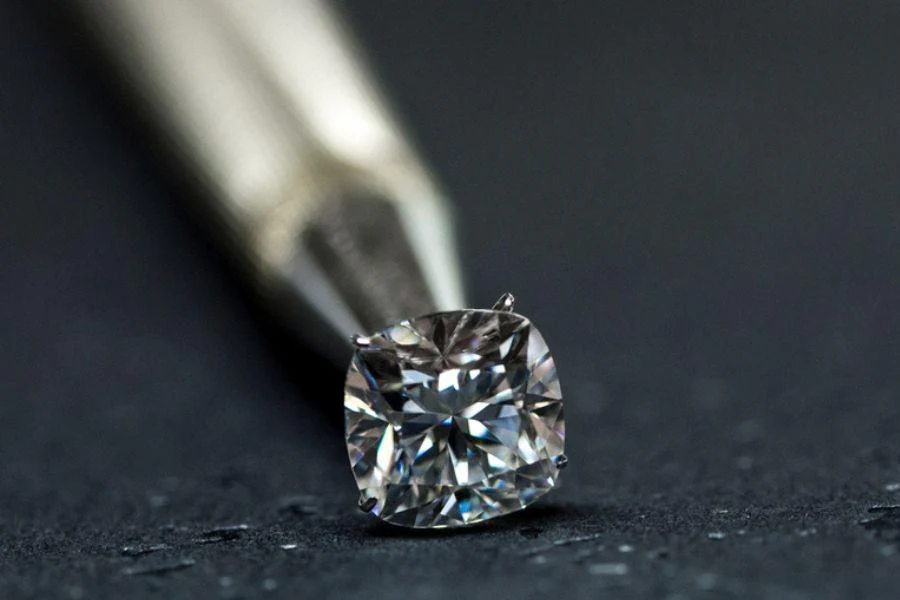
The classic cushion cut diamond is a timeless, luxurious diamond shape that evolved from the oldest diamond cut called the old mine cut.
This combination of old and new makes it vintage yet modern and desirable as an engagement ring for many women.
Its emerging popularity has mainly been due to the enhancements done to the cut over time. These adjustments include decreasing the culet, broadening the table, and refining cut angles for increased brilliance.
Also, cushion cut diamonds tend to be 25% less expensive than their round cut counterparts which is a huge benefit.
Many factors contribute to choosing the right cushion cut diamond. For instance, specific metrics, grades, colors, settings all matter. However, not everyone is aware of what clarity grade to choose, the correct length and width, or color grade.
Read on to discover what a cushion cut diamond is, its history, features, pros, cons, and everything else you need to know.
Cushion Cut Diamond: Background and History
The cushion cut diamond is an evolved version of its predecessor, the old mine cut. The old mine cut started in the 1700s, featuring 58 facets. As a result, a square-like shape with round edges emerged. Today, it remains one of the most popular diamond shapes.
It began rising in popularity during the Georgian Era and Victorian Era, roughly between the early 1700s to early 1900s.
Because it was a brilliant diamond in most lighting, including dim candlelight, it was the most popular during those two centuries.
Old mine cut diamonds were cut by hand and not under electrical lighting, resulting in less glistening and fire than modern-day cuts. As new cutting tools emerged and electricity was invented, the faceting improved, with the diamond’s cut reflecting light better.
As the old mine cut transformed into the cushion cut diamond, the notable differences include the cushion cut’s lower crown, larger table facet, lack of culet, and shallower pavilion.
Cushion Cut Diamond: Structure and Cut

There are four cushion cut categories, such as:
- Standard cushion cuts: The standard cushion cuts are mostly found in older cut diamonds, which are less brilliant.
- Modified cushion cuts: The modified cushion cuts emerged in the 1920s, with an additional row of facets below the girdle.
- “Chunky” cushions: If you find a cushion-cut with more back facets with broad, light reflections, it is most likely the “Chunky” cushion. Also called antique cushions because this is how Old Miner cuts used to present themselves.
- “Crushed-ice” cushions: The crushed-ice diamond-cut cushions have a more glittering effect, where the back facets are not distinct.
Overall, aesthetics depend on taste, as the cushion cut diamond presents four structures to select.
Selecting a Cushion Cut Diamond
When choosing diamonds, you must first consider the 4C’s:
- Cut: The most critical aspect is a diamond’s cut. The cut directly affects the fire and brilliance, impacting the appearance.
- Color: A diamond must look either white or colorless to the eye. The color must not distract or interfere with colored light or white reflections.
- Clarity: A diamond’s purity is in its clarity rating. It is broken down into six categories (11 grades), ranging from no inclusions to apparent inclusions.
- Carat: The weight of the diamond, which does not always match with its value. Consider the brilliance more than the weight.
Continue reading to find out what to look for when selecting a cushion cut diamond.
Diamond Color: Choose H or Higher
Cushions are peculiar when it comes to colors. If you want a colorless diamond, cushions are the worst in color retention. However, they can be the best at retaining color if you want a fancy colored diamond.
Cushions and radiant cuts retain their color stronger than any other shape.
Experts recommend selecting H or higher. I and J color cushions are best for yellow and rose gold. If you want vintage style, K color cushions are suitable.
H diamonds are near colorless with a slight yellow tint that’s not super noticeable, especially next to rose or yellow gold.
Overall, H diamond color is the best value option because of its price compared to a natural diamond color. H is somewhere in the middle, as color grade prices spike between each category.
Cut Guide: Depth and Table under 70% & G, VG, or E Symmetry
The cushion cut diamond shape is between round and square, with rounded corners and slightly curved sides.
It’s essential to choose the right cut and notice the square-like, rounded shape, making the diamond unique and timeless. When you are aware of cushion characteristics, you can correctly identify them without needing the certificate.
The parameters for cushion cuts are loose, such as:
- Depth: Below 70%
- Table: Below 70%
- Symmetry: Good, Very Good, or Excellent (G, VG, or E)
- Length: Your choice depending on the proportions
The symmetry or polish should be a minimum “Very Good” for the facets to be laid out correctly.
Clarity Guide: Stick to SI2 or SI1 Clarity for the Best Value
The clarity guide contains various grades in no particular order:
- Flawless (FL)
- Very Slightly Included (VS1 and VS2)
- Internally Flawless (IF)
- Included (I1, I2, I3).
- Very Very Slightly Included (VVS1, VVS2)
- Slightly Included (SI1, SI2)
A large open table means imperfections are clearer to see, meaning you want the least included stone you can afford.
Cushion cuts have a large open table, making it harder to find a clean SI2 with the naked eye. As a result, you may have to compromise and pay more for a higher clarity stone.
No diamond will be completely pure, but the clarity grade ensures blemishes do not overpower the diamond’s brilliance.
Length to Width Guide: Avoid the “Awkward Zone” of 1.06 to 1.10
The length-to-width (L/W) ratio is critical when selecting cushion diamonds.
Most square cushions should have an L/W of 1 to 1.05. Rectangular shapes will be slightly elongated at 1.15 to 1.20 L/W.
You must avoid 1.06 to 1.10, as the shape of these diamonds looks like an unrecognizable fusion of a square and rectangle.
It’s vital to get the correct measures, as the classification of cushions involves these metrics. Otherwise, you may select a diamond that is not a cushion-cut, losing time and money.
3 Main Types of Cushion Cut Diamonds
There are three main types of cushion-cut diamonds, such as:
- Old Mine Cut Antique Cushion: Known as the “miner cut” or “chunky cushion,” the old mine cut antique cushion was the main shape of the Victorian and Edwardian eras. What’s unique about it is that it’s rare and has many different looks.

- Cushion Modified Cut: The cushion modified cut’s most prominent feature is having an extra row of facets. The crushed ice appearance also creates a glittering appeal.

- Cushion Brilliant Cut: This type is considered rarer than the modified cut, as the brilliant-cut diamond has larger yet fewer facets. However, it sparkles more, akin to a round, brilliant cut. It is usually at an elongated shape of 1.10 to 1.25 length-to-width.

Cushion Cut Diamonds: Pros & Cons
While the cushion cut diamond is incredibly popular, there are pros and cons.
Pros:
- The round corners make it more durable
- A timeless and classic appeal
- It reflects all types of lights colors well due to high-level of brilliance and fire
- Less expensive than round-cut diamonds
- It continues to rise in popularity as it combines classic and modernity
- Allows for a more customized diamond engagement ring
Cons:
- Confusing terms may be an issue for buyers, such as chunky, modified, classic, crushed ice
- Imperfections are easier to spot
- Face-up size is smaller than most shapes, requiring a stone with a larger carat weight
- Not suitable for those seeking colorless diamonds, as it retains color well, and higher color grades are more expensive
Cushion-Cut vs. Round-Cut Diamond
There are significant differences between cushion-cut and round-cut, which can impact your purchasing decision.
Cushion-cut:
- Square-like with round edges
- Cushion-cuts cost less per carat
- More unique due to classic combination with modern features
- Larger facets that produce more fire
Round-cut:
- Hides color and inclusions better than cushions
- Fewer cuts to select
- Most people buy round-cuts, as they remain the most popular
- More expensive
- Offer more brilliance
Overall, the main differences are price, popularity, and choosing between brilliance and fire. For a full comparison, read our cushion cut vs round cut guide.
Cushion-Cut Diamond vs. Princess-Cut Diamond
The princess cut diamond has significant differences compared to the cushion cut.
Cushion-cut:
- Excels in vintage settings, including soft halos
- Its rounded corners make it appear smaller
- Offers solid brilliance and fire
- Comparable price per carat to princess-cut
Princess-cut:
- Looks impressive in geometric three-stone rings and edgy solitaires
- Perceived as larger due to our eyes observing the extended length from each corner
- Presents good fire and brilliance
- More popular
- Displays more color due to larger table
- Sharp angular corners make it more vulnerable
The most noticeable difference is the geometric shapes of the princess-cut, opposed to the cushion’s round edges.
Cushion-Cut Diamond vs. Radiant-Cut Diamond
Radiant-cut and cushion-cut exhibit different prominent features.
Cushion-cut:
- Smoother, trimmed corners for increased durability
- Presents more fire than radiant-cut
- More square-like shape; appears part rectangle part circle
- Usually, at a 1 to 1.09 length-to-width ratio
Radiant-cut:
- Distinct, beveled edges cut at 45° angle, giving a more geometric, angular shape
- It offers more brilliance than cushion-cut due to numerous facets, taking in and reflecting more light
Deciding between a cushion-cut and a radiant-cut comes down to preferences, as both are comparable in price. Both also have similarly large tables.
Best Setting and Style for Cushion Cut Diamonds
Picking a solid setting may bring out the best in cushion-cut engagement rings.
- The Best Style: Halo – The Halo setting is the perfect complement for the cushion diamond because it is vintage yet modern.

- Second Best: Channel Setting — The alignment of each center stone in these engagement ring settings creates a sparkling row, featuring a sleek and modern style.

- Still Dazzling: Pavé Setting — The pavé setting is a stunning choice for cushion cuts as small diamonds line in a band, providing an elegant appearance.

- Good Choice: Solitaire — The solitaire setting is simple yet timeless and remains popular because it highlights the cushion cut.

- Average: Vintage Setting —The cushion cut can go back to its roots with a vintage style, similar to Victorian, providing a unique, custom look.

- The Worst: Tension Setting — The tension setting doesn’t allow the cushion cut to reveal the round edges that make it unique.

Final Thoughts
Now that we’ve covered everything you need to know regarding the question “What is a cushion cut diamond?” Next is setting out to find one that fits your personality.
Remember to consider the 4 Cs. Choose the H color grade, in-depth round 70% shape, and avoid a length-to-width ratio of 1.06 to 1.10.
If you are unsure which setting you want, the Halo is one of the most popular engagement ring styles and always looks beautiful.
In all, cushion cuts are brilliant diamonds that are timeless and are very likely to remain popular for centuries to come so you can’t go wrong with this beautiful diamond.
NEW POSTS

November 24, 2025
Diamond Bracelets for Ladies – Your Guide to Sparkling Wrist Wear

November 24, 2025
Omega Necklaces Trend – Your 2025 Guide to Chic Neckwear

November 12, 2025

