
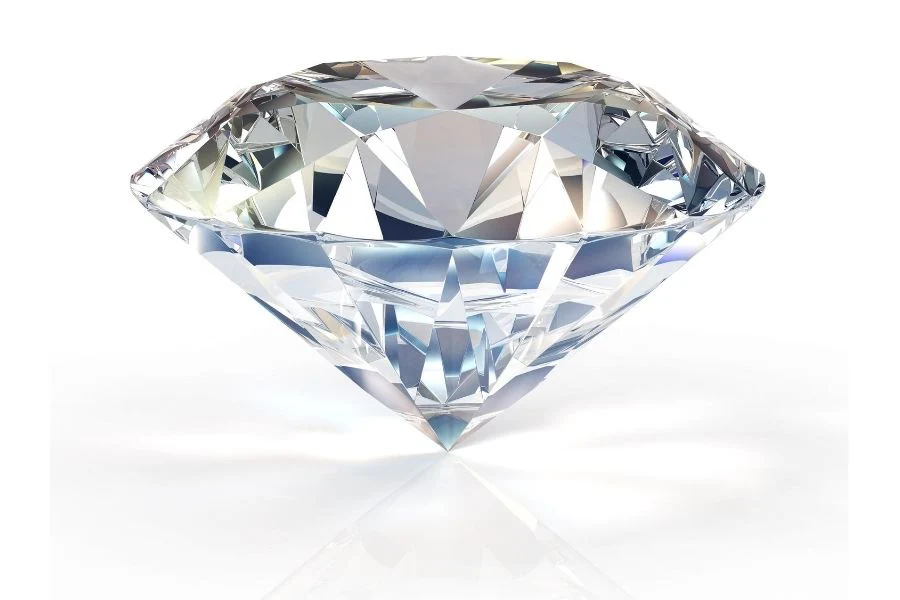
What is a Moissanite Diamond?
There’s a saying that diamonds are a girl’s best friend. As one of the most expensive gemstones and the hardest stone in the world, it’s no wonder that everybody wants them. However, there are some stones like it, and one of them is moissanite. In this article, we’ll explore the differences between a moissanite and a diamond. We’ll also discuss their properties—such as appearance, weight, and value. By the end of this, you’ll be an expert at telling the two apart.
What is Moissanite?
Moissanite is a gemstone. Dr. Henri Moissan, a French scientist and a Nobel Prize winner, discovered it in 1893 at the Meteor Crater in Arizona. At first, he thought he found the most brilliant stone of all time—one that could be better than diamonds. But later on, he found out that moissanite is naturally occurring silicon carbide.
Unlike diamonds, which are made of carbon, a moissanite is rare in nature, so it can’t be sourced for making jewelry. That’s why scientists developed the lab-grown moissanite, and it takes around 2–3 months to make a single stone.
Moissanite or Diamond: How can you tell?
Moissanites and diamonds can look the same from a distance, mainly when set in jewelry. So, how can you tell the difference between the two? Here are some things to take note of when checking:
Brilliance
Moissanites sparkle differently than real diamonds. They have a higher refractive index, which is the measure of the speed in which light travels through the material. Moissanite has a refractive index of 2.65–2.96.
Fire
Moissanite releases more “fire,” which is the vibrant rainbow light, than a real diamond. That’s why moissanites tend to shine regardless of what light they’re under.
Clarity
Lab-grown moissanites have higher clarity than diamonds. That’s because diamonds maintain a natural clarity, whereas lab-grown moissanites are given clarity during construction.
Color
Moissanites are transparent and, depending on size, may have a yellow or green tint when under certain lights.
Weight
A moissanite is 15% lighter than a diamond due to its lower density and specific gravity.
Value
Moissanites are cheaper than diamonds. They’re priced depending on the size and whether a stone is Premium or Super Premium.
Electricity Conduction
Diamonds are known to be electric insulators (meaning they’re bad at conducting electricity) and excellent thermal conductors (meaning they can handle high levels of heat), whereas moissanites are very good at conducting electricity and just okay thermal conductors compared to a diamond.
Moissanite vs Diamond

Durability/Hardness
The Mohs scale determines the hardness of a mineral, and a scratch test is performed between specimens in a Mohs scale kit. For example, if specimen A scratches specimen B, then specimen A is harder than specimen B. To date, the diamond is still the hardest known mineral, scoring a 10 on the Mohs scale. Meanwhile, moissanite registers a score of 9.25.
Brilliance
Moissanites and diamonds have different faceting patterns, so there’s a huge difference in brilliance. Moissanite emits fiery, rainbow flashes—more like a disco ball effect—especially when exposed to bright lights.
On the other hand, diamonds reflect light in three ways: 1) brilliance, which is the white light it reflects; 2) dispersion, which is the rainbow light refracted through the diamond; and 3) scintillation, which is the surface sparkle of the diamond. The combination of these three properties marks the brilliant shine of a diamond. However, diamonds don’t produce the disco ball effect that’s apparent with a moissanite.
Clarity
Clarity refers to the number of blemishes and internal inclusions of a stone. Since most moissanites are artificial and made in controlled environments, they tend to have a higher clarity, and that’s why moissanites are graded as nearly flawless.
But if compared to diamonds, moissanites are graded an average equivalent to VS Clarity on the GIA scale. Diamonds are graded flawless (FL), internally flawless (IF), and Very Very Slightly (VVS). The more flawless a diamond is, the higher its value.
Color Scales
Diamonds are graded using the GIA color scale, which can be seen below:
- Colorless – D, E, F
- Near Colorless – G, H, I, J
- Faint – K, L, M
- Very Light – N, O, P, Q, R
- Light – S, T, U, V, W, X, Y, Z
Moissanites, on the other hand, aren’t graded by color. And since moissanites aren’t colorless, they fall at the K grade on the GIA scale above. Here is the variety of moissanite colors:
- Classic Moissanite – has a color grading of J-K
- Forever One Moissanite – has a color grading of D-E-F
- Forever Brilliant Moissanite – has a color grading of G-H-I

Cut
These are the different moissanite cuts on the market:
- Round Brilliant
- Cushion
- Oval
- Emerald
- Radiant
- Square Radiant
- Heart
- Trillion
Among those, the most popular cut for moissanite in terms of brilliance, color, and versatility is the Round Brilliant cut. Such a cut has more brilliance and fire when exposed to bright lights and has a GIA color grade of colorless to nearly colorless. It’s also considered as the most versatile, as it looks perfect on any jewelry design.
Price
Moissanite is cheaper than diamonds. But unlike diamonds—which are priced based on the 4Cs (Carat, Color, Clarity, and Cut)—moissanites are priced based on size (millimeters) and whether they’re enhanced or unenhanced (Premium or Super Premium). For example, a one-carat diamond could cost $3,890, while moissanite with a size of 6.5 mm (close to one carat) could be priced at $850.
Sourcing
As we know, diamonds are mined. However, there are lab-grown diamonds, too, and they have the same physical, chemical, and optical properties as mined ones. Moissanites, on the other hand, are lab-grown due to their rarity in nature.
Moissanite Origins
Where does moissanite come from?
Moissanite is a naturally occurring silicon carbide and is a rare mineral. It was first discovered by the French chemist Henri Moissan in 1893 while he was examining rock samples from a meteor crater in Canyon Diablo, Arizona.
How are moissanites made?
Since silicon carbide is rare, so all products from this mineral are constructed using a synthetic version. A single moissanite gem usually takes 2–3 months to produce and it’s made with a combination of pressure and heat.

Choosing the Perfect Moissanite
When choosing the perfect moissanite, don’t just look at the price. You should also check the brilliance, hardness, color, clarity, and cut. If you’re eco-conscious, then this is a good choice since moissanites are lab-grown, meaning there’s no mining involved.
More Affordable Diamond Alternatives
- Colored gemstones – Amethysts, rubies, sapphires, and opals are some of the most popular colored gemstones. They’re also less expensive than diamonds on a per-carat basis.
- Lab-created diamonds – This type of diamond is less expensive than a mined one and is also an alternative if you’re eco-conscious. You’ll save around 30% but still get the same quality.
- Cubic Zirconia – These are much cheaper than moissanites and diamonds. A one-carat diamond can cost $3,630, whereas a one-carat cubic zirconia can be as cheap as $13.99.
CONCLUSION: Which is Better, Moissanite or Diamond?
When it comes to engagement rings, diamonds are always the first choice. They’re durable, brilliant, and elegant. But, if budget is a concern and if more sparkle is preferred, then go for moissanite. Both moissanite and diamonds are beautiful gems. As such, it really comes down to budget and personal preference.
FAQs
Can moissanite be considered a diamond?
No, it can’t.
Is moissanite a precious stone?
No, it isn’t. The only precious stones are rubies, sapphires, emeralds, and diamonds.
Does moissanite get cloudy?
No, Moissanites don’t get cloudy over time, unlike cubic zirconia.
Does moissanite last?
Yes, it does. Like diamonds, moissanites are strong and durable. With proper care, it can last a lifetime and be passed through generations.
NEW POSTS

November 24, 2025
Diamond Bracelets for Ladies – Your Guide to Sparkling Wrist Wear

November 24, 2025
Omega Necklaces Trend – Your 2025 Guide to Chic Neckwear

November 12, 2025

